 All articles
Foot knowledge · 5 min read
The foot and the body: knees, pelvis, back
The body is one system. The position of the foot travels up the chain to the shin, knee, pelvis and spine. Here is how it works.
The load chain
When we stand and walk, body weight passes through the legs to the ground, and the ground pushes back up. The foot is at the start of this chain. The position of the foot bones affects the position of the tibia and fibula, they affect the knee joint, and the knees affect the pelvis.
Natalia Romanchuk puts it this way: if the foot stands crooked, the knee will stand crooked too, and the pelvis will be tilted. The body is a single system, and this is most visible in walking, when the chain works thousands of times a day.
What happens when support is off
The most common example is overpronation, when the arch drops and the foot rolls inwards. The shin follows by rotating inwards, the knee starts to drift inwards, and the thigh rotates too. The pelvis may tilt, and the lower back may compensate by changing its curve.
If the two feet work differently — for example, one sags more than the other — the body receives an asymmetric load. One side of the pelvis may sit higher, and muscles on the two sides work unequally. Over time this can affect posture.
- Foot: the arch drops and the heel tilts.
- Shin and knee: rotation and the knee drifting inwards.
- Pelvis: tilt or rotation.
- Back: compensation through changes in its curves.
It works the other way too
The chain does not only run from the bottom up. Weak hip or glute muscles, a tilted pelvis or the after-effects of a knee injury also change how the foot meets the ground. So the foot cannot be looked at apart from the rest of the body — but the body cannot be “fixed” while ignoring its base either.
An important note: not every knee or back pain comes from the feet. There can be many causes, and an in-person assessment by a specialist helps sort them out. But checking how your support works is almost always worthwhile.
Signs worth noticing
A few simple observations can show whether your support is in order. They do not replace an examination, but they can tell you your feet need attention.
- Your shoes wear unevenly, especially on the inner or outer edge.
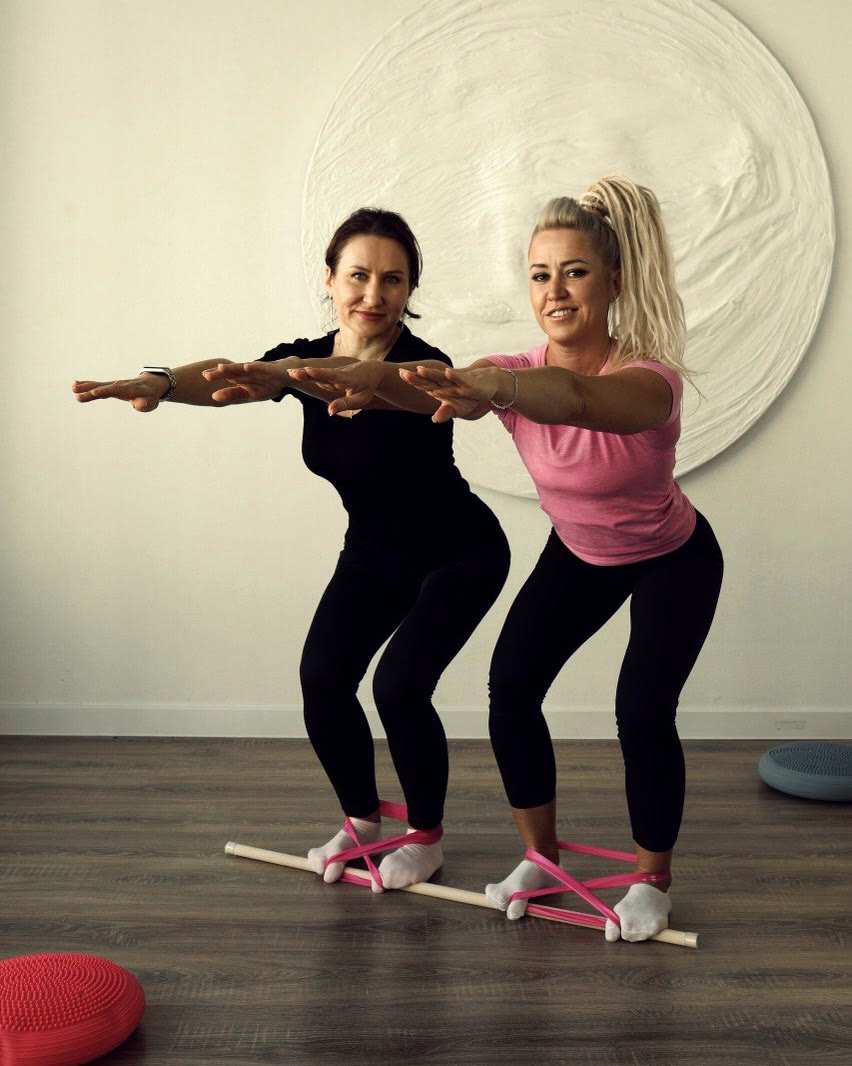
- When you squat in front of a mirror, your knees drift inwards.
- Your feet turn out strongly when you walk.
- Your legs tire quickly, with heaviness or aching by evening.
- One foot looks noticeably flatter than the other.
An everyday example: the knee on the stairs
Imagine climbing stairs. If the arch of the foot sags, with every step the shin turns slightly inwards and the knee drifts inwards with it. The ligaments and muscles around the knee are loaded at an angle they are poorly suited to. One such step means nothing, but stairs every day for years add up to a significant load.
That is why, when people complain about their knees, specialists often look at the feet too: how the person stands, squats and places a foot on a step. Sometimes strengthening the foot and learning proper support noticeably unloads the knee.
Children: feet and posture
In Natalia Romanchuk’s practice there are many children who have both flat feet and posture problems or scoliosis. This is no coincidence: a child’s body grows fast, and poor support affects how the knees, pelvis and spine develop.
If a child has posture problems, it is worth looking at their feet as well. And the other way round: foot work in childhood lays a foundation for the future. For prevention, children can start from 5–6 years old, ideally with an adult watching their technique.
The same chain when standing and sitting
The chain works not only in motion. Many people stand for long periods with their weight on one leg, and always the same one. The supporting foot sags more, the pelvis rises on that side, and the body gets used to the tilt. When sitting, we often cross our legs or tuck our feet under the chair — again, usually to one side.
It is hard, and unnecessary, to give up such habits completely. What matters is changing positions, standing on both legs with weight on the three points of each foot, and moving more often. The more varied the load, the less likely the body is to lock in an asymmetry.
Where to start
Working on your support starts with understanding how the foot is built and how it should move. Then you need regular exercise in the right order: wake up the tissues of the sole, strengthen the muscles and train balance. Step by step, the foot returns to its role as the foundation, and everything above has an easier time.
This article is educational and does not replace a doctor’s consultation. If you have acute pain, an injury, swelling or numbness, see a doctor.