 All articles
Foot knowledge · 5 min read
How the foot is built: anatomy in plain words
The foot is small, but it is more complex than many other parts of the body. Here is what it is made of and why every part matters for walking, balance and posture.
Bones and joints
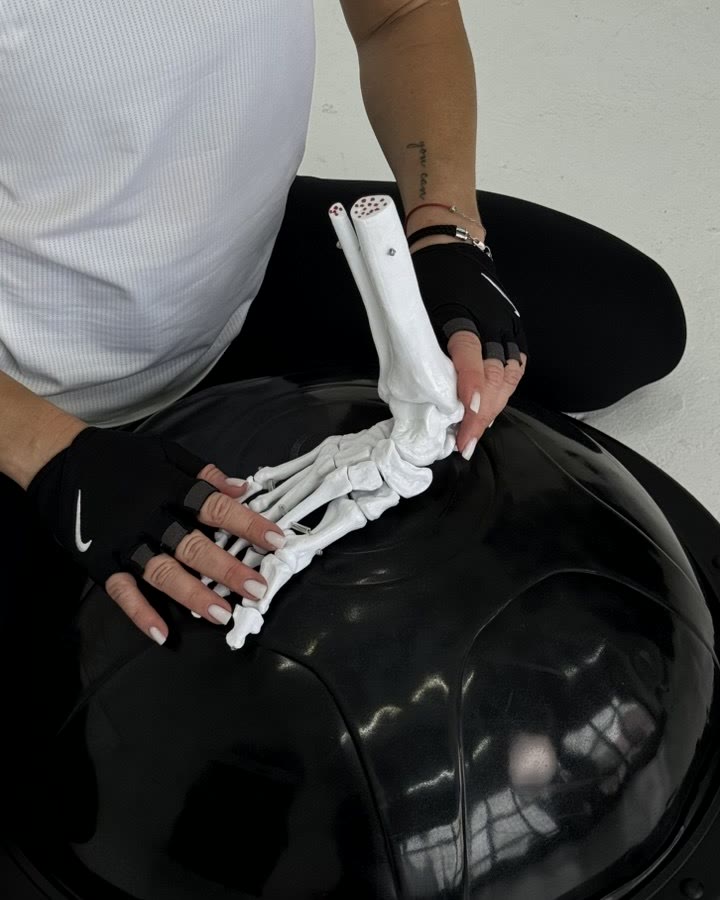
Each foot has 26 main bones plus a few small sesamoid bones. Together, the two feet hold about a quarter of all the bones in the skeleton. Between these bones are more than 30 joints, and almost all of them need to move: that mobility is what lets the foot adapt to uneven ground.
The bones of the foot are grouped into three parts. The tarsus is the back and middle of the foot: the heel bone we stand on, the talus that connects the foot to the shin, plus the navicular, the cuboid and three cuneiform bones. The metatarsus is the five long bones in the middle. The phalanges are the toe bones: two in the big toe and three in each of the others.
The ankle joint mainly moves the foot up and down. The subtalar joint below it lets the foot tilt inwards and outwards. When these joints move freely, each step is soft and the load is spread evenly.
The arches: a natural spring
The foot is not flat. Its bones are arranged in arches, and there are three of them. The medial longitudinal arch is the highest: you can see it as the curve on the inner side of the foot. The lateral longitudinal arch is lower and works mainly as support. The transverse arch runs across the foot at the level of the metatarsals.
Thanks to the arches, the foot has three main points of support: the heel, the base of the big toe and the base of the little toe. Body weight is shared between them, like a stable tripod. When the arches drop, this balance is lost: some areas get overloaded while others barely work.
The arches are held up not only by the shape of the bones. Ligaments and muscles support them all the time. That is why weak muscles let the arches sag, and stronger muscles help them keep their shape.
Muscles, ligaments and the plantar fascia
There are two kinds of foot muscles. The intrinsic muscles lie within the foot itself, mostly on the sole, in several layers. They are short and handle the fine work: curling and spreading the toes, holding the arches and helping with balance. The extrinsic muscles start on the shin, and their tendons run down to the foot. For example, tibialis posterior supports the inner arch, while peroneus longus runs under the foot and works with tibialis anterior like a stirrup.
Ligaments connect the bones and make the whole structure strong. The best-known structure of the sole is the plantar fascia, a dense band running from the heel bone to the base of the toes. When we rise onto our toes and the toes bend back, the fascia tightens like a winch cable and the arch lifts. This turns the foot from soft to rigid, ready to push off.
- Intrinsic foot muscles: fine control and arch support.
- Shin muscles: strength, push-off and control of foot position.
- Ligaments and fascia: a strong frame that works together with the muscles.
Nerves and blood supply
The sole has a great many nerve endings. They constantly tell the brain what we are standing on, where our centre of gravity is and whether we need to adjust our posture. This is called proprioception, the sense of body position. When the foot goes “quiet” because of tight shoes or too little movement, balance and coordination suffer.
Blood reaches the foot through the arteries of the shin and flows back up through the veins. The work of the shin and foot muscles during walking helps blood return to the heart. This is one reason legs feel heavy in the evening after long sitting or standing.
If your foot goes numb, tingles, feels cold or changes colour, have it checked by a doctor: these can be signs of nerve or blood vessel problems, and exercise is not the first step.
Toes: small but important
Toes are often seen as an “extra” part of the foot, but they are not. The big toe takes a large share of the load at push-off: it is what we leave the ground through. The other toes help with balance, especially when we stand still or walk on uneven ground.
In tight shoes the toes stay squeezed and barely move for years. The muscles that control them weaken, the joints lose mobility, and the big toe may gradually drift sideways. That is why foot exercises pay a lot of attention to the toes: spreading them, curling them and pressing them into the floor.
Why this matters for practice
Once you understand how the foot is built, exercises stop being a set of random movements. It becomes clear why we massage the sole, why we strengthen the muscles and why balance training matters as much as strength. That is why the Feet course starts with theory: structure first, practice second.
This article is educational and does not replace a doctor’s consultation. If you have acute pain, an injury, swelling or numbness, see a doctor.