 All articles
Foot knowledge · 5 min read
How the foot works when you walk
In a single step the foot acts as a soft shock absorber, a flexible support and a rigid lever. Here is how that happens and what gets in the way.
A step has phases
Every step is a cycle. About 60% of the time the leg is on the ground (the stance phase), and the other 40% it swings forward (the swing phase). The most interesting work for the foot happens during stance.
First the heel touches the ground. Then the foot lowers and takes the body’s weight. Next the body rolls over the foot, the heel lifts, and we push off with the front of the foot, mainly the big toe. After that the leg swings forward and the other foot takes over.
- Heel contact: stance begins.
- Loading: the foot softens the impact.
- Roll-over: the body passes over the foot.
- Heel lift and push-off through the big toe.
Pronation and supination are normal
“Pronation” often sounds like a diagnosis, but it is a natural movement. As the foot takes weight, it rolls slightly inwards, the arch lowers a little and the foot softens. That is pronation: it is how the foot absorbs impact and adapts to the surface.
By the time of push-off everything changes. The foot turns the other way — this is supination. The toes bend back, the plantar fascia tightens, the arch rises and the foot becomes a rigid lever that is easy to push off from.
Problems begin when there is too much movement, too little, or it happens at the wrong moment. For example, if the foot stays rolled in at push-off, it pushes like a soft cushion: the work shifts to other parts of the leg, and they get overloaded.
Shock absorption and load
In ordinary walking the load on the foot is greater than body weight, and in running it rises several times more. We take thousands of steps a day, so even a small inaccuracy in how the foot works is repeated thousands of times.
Several mechanisms absorb shock at once: the fat pad under the heel, the flexibility of the arches, the work of the foot and shin muscles, and the bending of the knee. If one mechanism is weaker, the others take on extra work. Over time this can show up as fatigue, pain or a change in gait.
Balance: the foot–brain connection
The foot is the main balance sensor. Receptors in the sole, muscles and ligaments constantly send the brain information about body position, and the brain instantly answers with signals to the stabilising muscles. The faster this exchange, the more confidently we walk, especially on uneven ground.
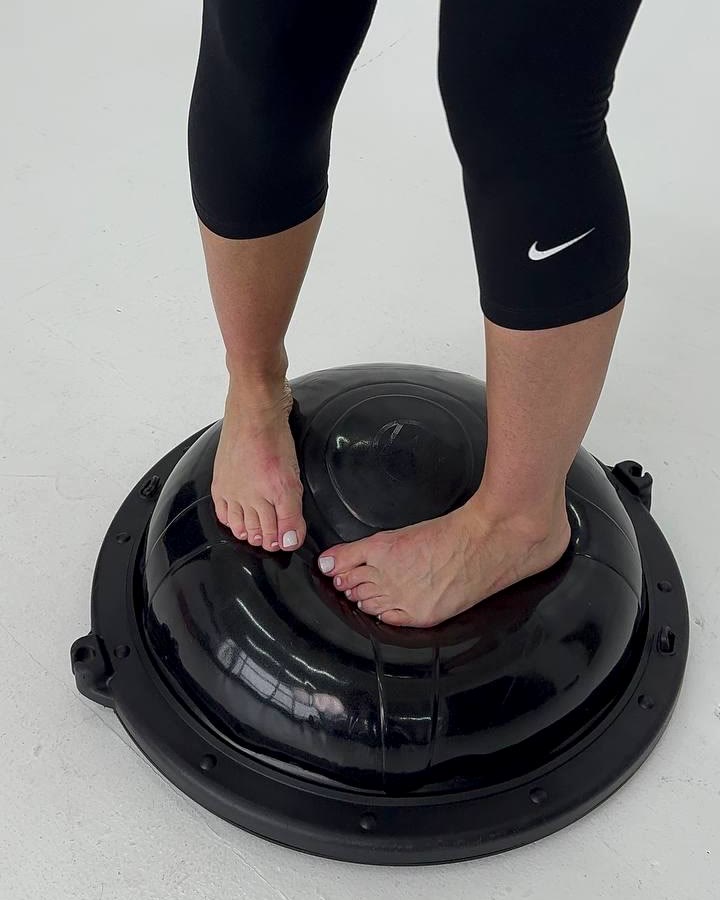
This connection can be trained. Exercises on a balance board teach the foot to react quickly and switch on the right muscles. That is why balance is an essential part of the Feet course, not an extra.
What gets in the way
A few common things stop the foot from working well when you walk. They usually act together rather than one at a time.
- Tight or uncomfortable shoes in which the toes and arch cannot move.
- Weak foot and shin muscles: the arches sag and push-off becomes weak.
- A stiff ankle: if the foot does not bend up well, the step gets shorter and the load moves to other joints.
- A stiff big toe joint: push-off shifts to the outer edge of the foot.
- The after-effects of old injuries, after which a person got used to protecting the leg.
- A lot of sitting and little walking, especially on varied surfaces.
How to notice your gait has changed
Other people often notice gait changes before we do. Clues include unevenly worn soles, a “slapping” sound when you walk, getting tired quickly on an ordinary walk, or a feeling that one leg does more work than the other.
You can ask someone to film you walking from behind and from the side. On video it is easy to see whether your feet land parallel, whether you push off through the big toe and whether your feet roll inwards.
Walking on different surfaces
The modern foot spends almost all its time on flat floors and pavement, and in shoes. It rarely has to adapt to uneven ground, so the small muscles and receptors of the sole work less than they could. Walking barefoot on grass, sand or pebbles, where it is safe, gives the foot varied loading and trains balance. Start a little at a time — a few minutes a day, especially if your feet are not used to it.
At home you can walk barefoot on mats with different textures. It does not replace exercise, but it helps the foot “wake up” and feel the floor better.
Why support matters for the whole body
The foot is the first link that meets the ground. How it takes weight and pushes off affects how the shin, knee, pelvis and back work. You can read more about this chain in the article “The foot and the body”.
The good news: how the foot works can be improved. Mobile joints, strong muscles and trained balance make each step softer and steadier.
This article is educational and does not replace a doctor’s consultation. If you have acute pain, an injury, swelling or numbness, see a doctor.