

 All courses
Online course
Feet
Attention to every movement. A step-by-step video practice for your feet at your own pace.
- 33 videos
- 3 modules
- At your own pace
 33 videos
 3 modules
 At your own pace


From introduction to practice
Start with the introduction and prepare for practice. Then work through the exercises in order, revisit familiar movements and finish with the closing section. Your place is saved so you can continue on any device.

Course curriculum
3 modules33 videos
01Introduction and preparationVideos: 2 / 2

-
Introduction7:14
-
Preparing for the exercises1:56

02Practice: step by stepVideos: 30 / 30
-
Exercise 12:23
-
Exercise 21:57
-
Exercise 31:47
-
Exercise 41:50
-
Exercise 52:04
-
Exercise 62:02
-
Exercise 72:17
-
Exercise 82:03
-
Exercise 92:12
-
Exercise 102:13
-
Exercise 112:09
-
Exercise 121:47
-
Exercise 132:00
-
Exercise 141:49
-
Exercise 152:03
-
Exercise 161:57
-
Exercise 172:05
-
Exercise 182:18
-
Exercise 192:15
-
Exercise 202:09
-
Exercise 211:55
-
Exercise 222:42
-
Exercise 232:13
-
Exercise 242:22
-
Exercise 252:29
-
Exercise 262:47
-
Exercise 272:56
-
Exercise 282:09
-
Exercise 291:58
-
Exercise 302:04
03Completing the courseVideos: 1 / 1
-
Closing section3:04

Course access
-
Lifetime access
Learn at your own pace and return to lessons at any time.
-
One device
You can watch the course on one device at a time.
-
Online only
Downloading videos to your device and recording your screen are prohibited.
-
Personal access
Sharing course access with other people is prohibited.


Who the course is for
- People whose legs feel tired and heavy by evening.
- Anyone who wants stronger feet, better support and better posture.
- People who stand, walk or train a lot.
- Parents: prevention for children from 5–6 years old, earlier when there is a medical reason.
- Everyone who wants to understand how the foot works and practise with a system rather than at random.
Who should see a doctor first
- If you have acute pain, swelling or a fresh foot injury.
- After recent leg surgery — only with your doctor’s approval.
- With diabetes and reduced foot sensation, serious vascular disease or other chronic conditions — after agreeing it with your doctor.
- With a rigid, one-sided or rapidly worsening flat foot — get examined first.
The course is educational and does not replace treatment.
What you will learn
- How the foot is built and how it works when you walk.
- How to work through your foot with a ball on your own.
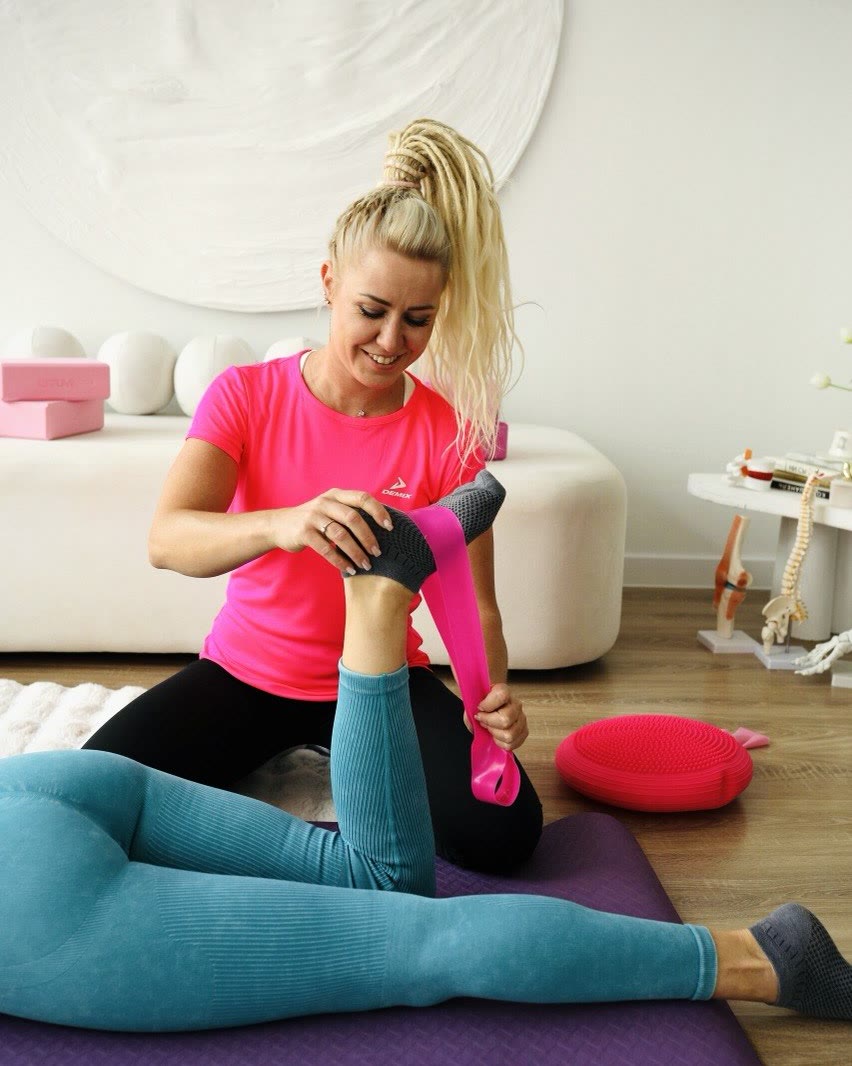
- How to activate, strengthen and stretch the foot muscles with a band.
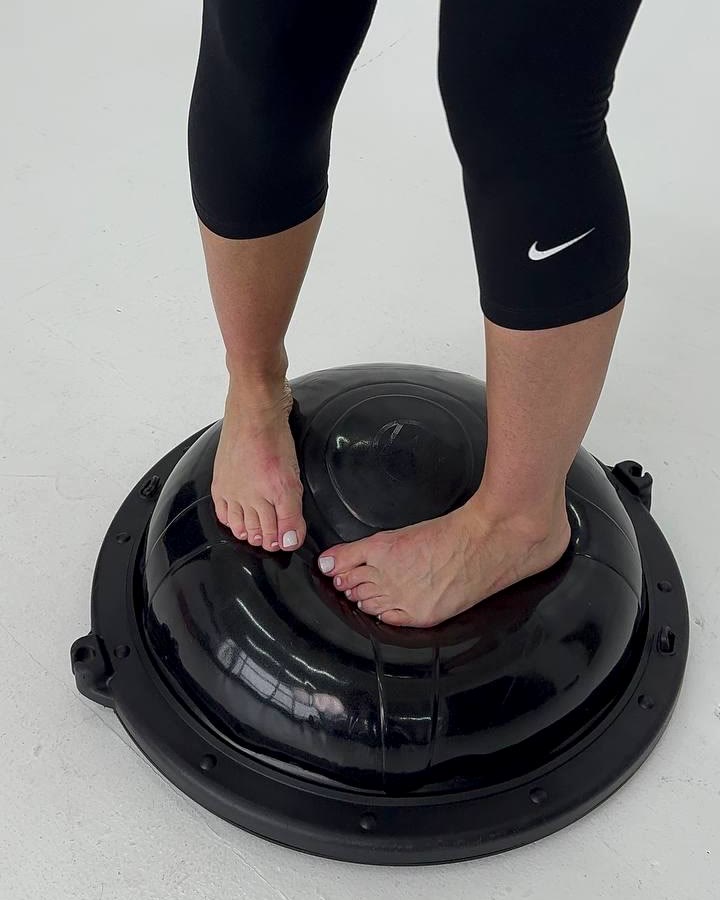
- How to train balance and the foot–brain connection on a balance board.
- How to stand on the three support points of the foot in everyday life.
- How to practise regularly and dose the load correctly.
How the course is organised
Introduction and preparation
Theory first: the structure and functions of the foot in plain language. Then an introduction to how to do the exercises. We do not move to practice without understanding the theory.
Practice, step by step
30 exercises in a clear sequence that Natalia has built over 15 years of practice. The ball gives a massage effect and loosens every bone, the band activates and strengthens the muscles, and balance restores the foot–brain connection and switches on the stabilising muscles.
Completing the course
The final part: how to consolidate your results and keep practising so that they last.
What you need and why
A small tennis ball
A massage and manual effect: you work through the sole and loosen every bone yourself.
A resistance band
Activates the muscles, strengthens and stretches them.
A balance board
Trains balance, fast signalling to the foot and the stabilising muscles that matter for walking.
All three work together as one system.
How to practise
3 times a week
At least three sessions a week. Regularity matters more than duration.
20–30 minutes
That is the length of one session — easy to fit into an ordinary day.
In order
Master one exercise before moving on to the next. Increase the load gradually.
A week and a month
In Natalia’s experience, you feel a result within a week and see it after about a month. After that it needs to be consolidated. Everyone progresses at their own pace.
If a child is practising
For prevention, children can confidently start from 5–6 years old, and earlier if there are health problems and a medical reason. A responsible child can practise alone, but many children find it hard to make themselves do it, so it is best if an adult — a parent or a specially trained person — keeps an eye on their technique.
Common mistakes
- Rushing and skipping ahead: one exercise isn’t mastered and the next one has already begun.
- Practising chaotically, without a system or an understanding of how the foot works.
- Waiting for the problem to go away by itself and losing time.
- Practising irregularly: an occasional session does not lock in results.
- Working through sharp pain.
Questions and answers
Do I need any preparation to start?
No. The course starts with theory and an introduction to how to do the exercises. Then you go through it in order.
How often and how long should I practise?
At least 3 times a week for 20–30 minutes.
When will I see results?
In Natalia’s experience, changes are felt within a week and seen after about a month. Results are individual, and it is important to consolidate them with regular practice.
Is the course suitable for children?
For prevention, from 5–6 years old; earlier when there is a medical reason. It is best if an adult keeps an eye on the technique.
Is the course suitable for flat feet?
The course aims to strengthen the muscles and restore how the foot works, which matters with flat feet. If the flat foot is rigid, one-sided or painful, see a doctor first.
I was prescribed insoles. Do I need the course?
Wear your insoles as your doctor advised. An insole supports the foot but does not train the muscles, so exercise is needed alongside it.
What if I feel pain during a session?
Mild muscle fatigue is normal. With sharp pain, swelling or numbness, stop the session and see a doctor.
What equipment do I need?
A small tennis ball, a resistance band and a balance board.
Which devices can I watch on?
Phone and computer. The course can be watched on only one device at a time.
How long does access last?
Access to the course has no time limit: come back to the lessons whenever you like.
Can I get a refund for the course?
Payment for the course is not refunded once access has been opened. If access did not open or you were charged twice, write to us — details are on the Refunds page.
How do I get in touch if something doesn’t work?
Our phone and email are on the Contact page. We reply from 10:00 to 16:00 Minsk time.
Course author
Natalia Romanchuk is a rehabilitation specialist and exercise therapy instructor with 15 years of working with the body, 11 of them in rehabilitation. Since 2021 she has run her own studio, Health Technique, in Minsk. The course is recorded the way she works with clients: simply, step by step and without rushing.
Once payment is confirmed, the course will automatically appear under “My courses” in your account.