 All articles
Foot knowledge · 4 min read
Foot exercises: why and how to practise
You can work on your feet at home if the programme is well designed. Here are the principles of safe practice, how much to do and the most common mistakes.
Why feet need exercise
The foot holds its arches and controls each step with its muscles. When they weaken, the arches sag, shock absorption gets worse and the load moves higher up. Exercises aim to restore the biomechanics of the foot: mobility to the joints, strength to the muscles and a clear connection between the foot and the brain.
The good news, from Natalia Romanchuk’s experience: these exercises are easy to learn on your own if there is a clear system.
Three tools, one system
The Feet course uses a ball, a resistance band and a balance board. They work as one system, and each has its own job.
- The ball gives a massage and manual effect: you work through and loosen every bone of the foot yourself.
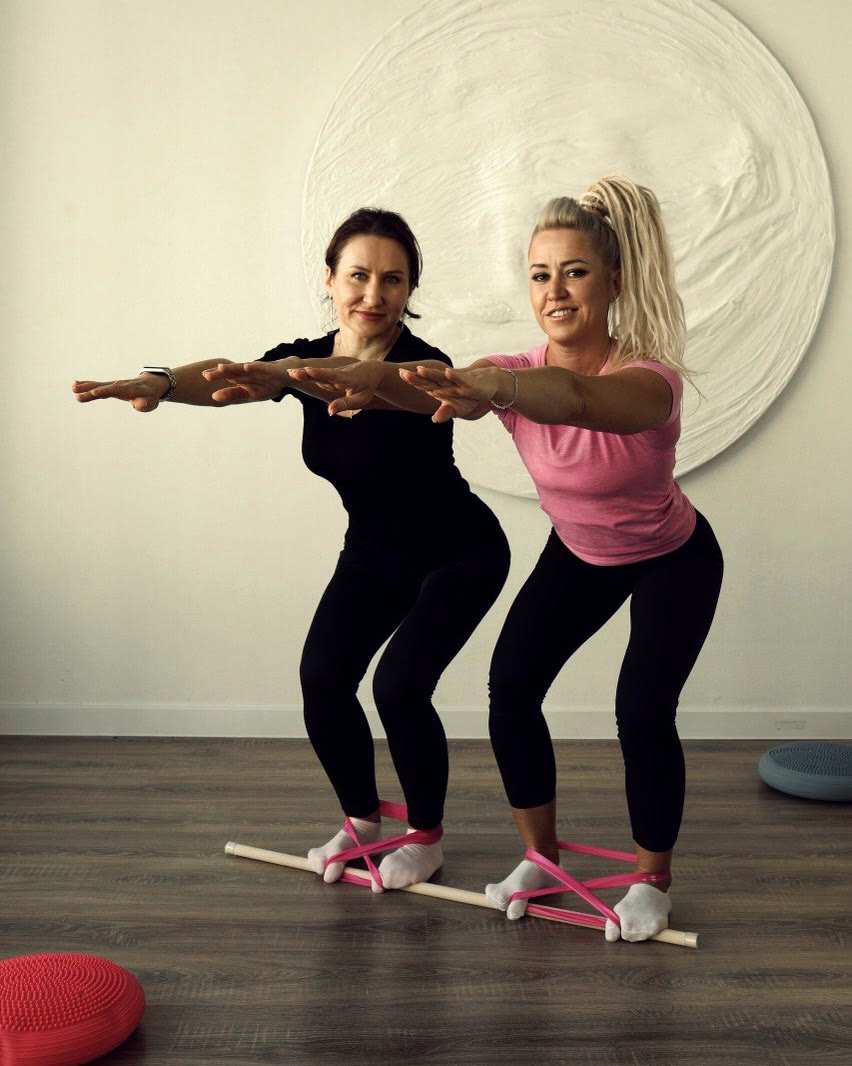
- The band switches the muscles on, strengthens and stretches them.
- Balance restores the foot–brain connection, speeds up signals, and switches on coordination and the stabilising muscles that matter for walking.
How much and how often
At least three times a week for 20–30 minutes. In Natalia’s experience, you feel a result within a week and see it after about a month. After that it needs to be consolidated, and you keep practising so that it lasts.
Regularity matters more than duration. Three short sessions a week will do more than one long session every two weeks.
Principles of safe practice
- Theory first: understand how the foot works, then move on to exercises.
- Order: master one exercise before moving to the next.
- Quality over quantity: fewer repetitions, done precisely.
- No sharp pain: mild muscle fatigue is normal; sharp pain is a signal to stop.
- Gradual progress: increase the load once the current one feels confident.
Common mistakes
Natalia highlights three main mistakes. The first is not noticing the problem or not believing it exists. The second is losing time hoping it will go away by itself. The third is starting exercises chaotically, without a system or an understanding of how the foot works.
Another common mistake is rushing. People want quick results and skip ahead: they haven’t mastered one exercise and are already doing the next. As a result, technique suffers and progress is delayed.
What a session looks like
A typical session goes from simple to more complex. First the ball: the sole is massaged, the tissues “wake up” and the foot feels the floor better. Then the band: the muscles switch on, get stronger and stretch. Finally balance: the foot learns to react quickly and the body to stay steady. The order is deliberate: prepare the tissues, then load them, then teach them to work together.
How to tell you are making progress
Changes usually come gradually. Natalia describes them like this: pain and discomfort go away, the way you walk changes, and you discover muscles in your body you never felt before.
- Your legs are less tired by evening.
- Standing on one leg becomes easier and lasts longer.
- Exercises that were hard become confident.
- You feel supported through the whole foot.
Where and in what to practise
A small space at home is enough: a mat, a chair and the equipment — a ball, a band and a balance board. It is best to practise barefoot or in socks so that the foot feels the floor. Place your phone or laptop so you can see the lesson and yourself at the same time, and keep something to hold on to — a wall or the back of a chair — for balance exercises.
If you miss sessions
Breaks happen to everyone: illness, a trip, a busy week. Don’t try to catch up on everything in one day. Return to your usual rhythm of three times a week, and if the break was long, repeat a few earlier exercises before moving on. A system works when it is regular, not when it is perfect.
When to postpone exercise
Do not exercise if you have acute foot pain, swelling, a fresh injury, a fever or numbness. In these cases, see a doctor first. If you have a chronic condition or have recently had surgery, agree on exercise with your doctor.
For children, preventive foot work is suitable from 5–6 years old. It is best if an adult keeps an eye on their technique.
This article is educational and does not replace a doctor’s consultation. If you have acute pain, an injury, swelling or numbness, see a doctor.